Why Heat Insulation Matters in Zanzibar

When people think about energy efficiency, they often think about solar panels first. But in Zanzibar, there is an even more important question:
How much energy does the building actually need?
Because on the island, two resources exist in completely different amounts:
- The sun is abundant.
- Electricity is limited and expensive.
If we design a building that constantly heats up and then try to cool it using air conditioning, we are effectively trying to fight the island’s strongest resource with one of its weakest.
That is rarely an efficient strategy.
The Problem: Heat Enters the Building All Day Long
A house gains heat from several sources:
- Solar radiation through roofs and walls
- Direct sunlight through windows
- Warm outdoor air
- Heat stored inside building materials
In tropical climates, roofs and walls can remain exposed to strong sunlight for many hours every day.
Without insulation and shading, this energy moves directly into the interior.
The result is familiar:
- Indoor temperatures rise
- Air conditioners run longer
- Electricity demand increases
- Comfort decreases when power is unavailable
Understanding Heat Conductivity
Heat naturally flows from warmer areas to cooler areas. How quickly this happens depends on the material.
This property is called thermal conductivity and is measured in W/m·K. Lower numbers mean heat moves more slowly. Higher numbers mean heat passes through more easily. :contentReference[oaicite:0]{index=0}
Dense concrete and heavy concrete blocks typically have thermal conductivity values around:
- Dense concrete: approximately 1.1–1.4 W/m·K
- Heavy concrete blocks: approximately 1.6 W/m·K
Insulating materials are dramatically lower. Lightweight insulated materials may reach values below 0.2 W/m·K. :contentReference[oaicite:1]{index=1}
This means heat travels many times faster through a dense concrete wall than through a properly insulated wall.
Why Full Concrete Walls Become Hot
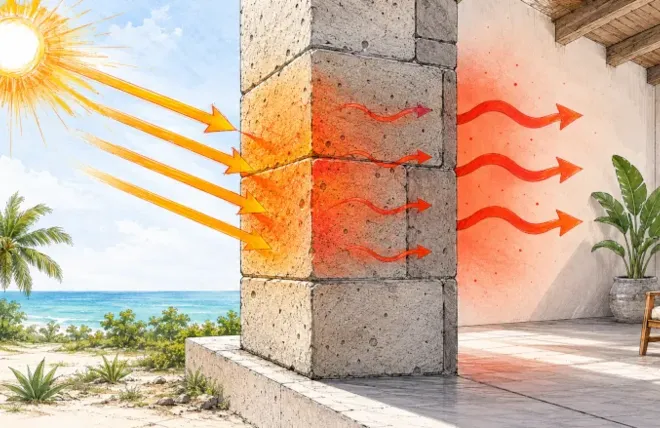
Concrete has something called thermal mass.
Thermal mass means a material can absorb and store large amounts of heat. Concrete does this very well. :contentReference[oaicite:2]{index=2}
That sounds positive at first — but in tropical climates there is an important detail:
If thermal mass is exposed to continuous heat without insulation and without night cooling, it becomes a heat battery.
Walls absorb solar energy throughout the day and release it later into the rooms.
So even after sunset, the house may still feel warm.
Changing the Material Changes the Building
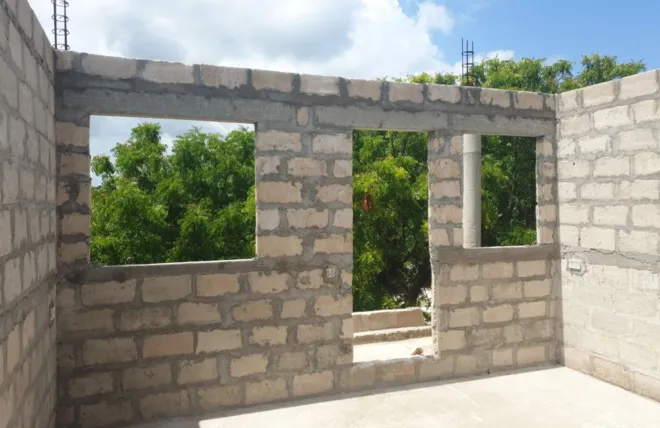
The goal is not necessarily to eliminate concrete. Concrete remains an important structural material.
The goal is to place materials where they perform best.
Examples include:
- Insulated wall assemblies
- Roof insulation
- Lightweight blocks with lower conductivity
- Ventilated facades
- External shading
- Proper orientation of openings
Thermal mass performs best when paired with external insulation and protected from direct summer sun. :contentReference[oaicite:3]{index=3}
Cooling Starts Before Air Conditioning
The cheapest energy is the energy that never needs to be produced.
A well-designed building reduces heat gain first. Then ventilation and shading reduce temperatures further. Only after that should mechanical cooling become necessary.
This approach creates several advantages:
- Lower electricity bills
- Less dependence on unstable grid supply
- Smaller solar systems
- Greater comfort during outages
- Longer equipment lifetime
Use the Strongest Resource Correctly
Zanzibar’s greatest energy source is not electricity. It is the sun.
The question is whether we allow that energy into the building — or whether we design intelligently and work with the climate instead of against it.
A cooler building is not created by stronger air conditioning. It is created by preventing unnecessary heat from entering in the first place.