Why Prefabrication Can Improve Quality & Valuable Time

Construction is often thought of as a sequence of visible milestones: foundations, walls, roof, finishes. But in reality, many delays happen in the transitions between those stages — especially when one element must wait for another to harden, cure or be corrected.
One example is the humble window beam.
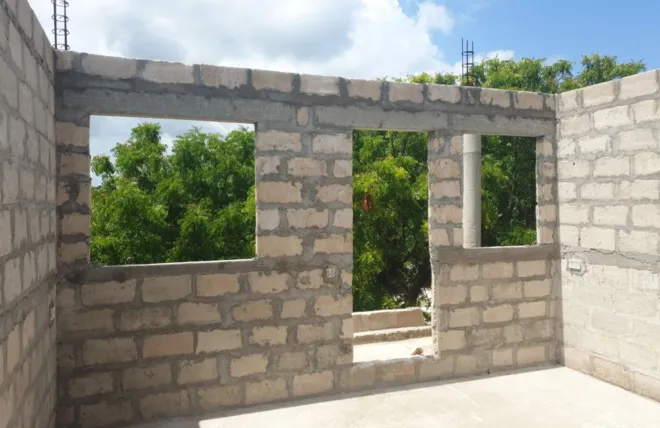
At first glance, a window beam seems simple: install formwork, place reinforcement, pour concrete and continue building. But this small step often becomes a bottleneck.
Prefabrication changes that.
The Traditional Way: Casting Window Beams in Place
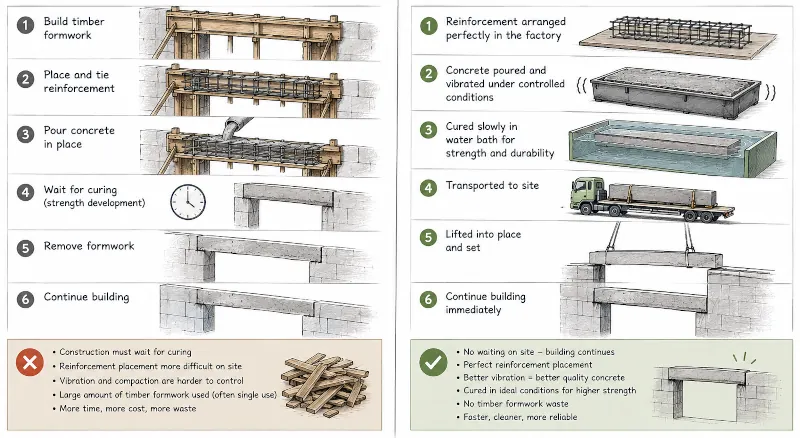
When window beams are cast directly on the construction site, the process usually looks like this:
- Build temporary timber formwork
- Cut and place reinforcement
- Pour concrete in position
- Compact as well as conditions allow
- Wait for curing and strength development
- Remove formwork
- Continue building
That sequence sounds straightforward — but every step depends on the previous one.
Concrete does not become strong immediately. Proper curing is essential for strength and durability. Keeping concrete moist during curing improves strength development, reduces permeability and lowers the risk of cracking.
The Hidden Cost: Waiting
Construction schedules are built around dependencies.
If window beams are cast in place:
- Masonry above must often wait
- Formwork remains occupied
- Workers move to other tasks
- Sequencing becomes more difficult
A delay of a small structural element can slow much larger parts of the project.
Prefabrication changes this completely because manufacturing and site work happen in parallel rather than sequentially.
Better Reinforcement Placement
Another challenge with site-cast beams is reinforcement positioning.
On a busy construction site:
- Bars may shift
- Spacing may vary
- Access is limited
- Inspections become more difficult
In a prefabrication environment, reinforcement can be:
- Prepared on level casting tables
- Positioned precisely
- Checked before pouring
- Kept consistent from beam to beam
Factory-style production allows tighter quality control and more repeatable results.
Better Compaction Means Better Concrete
Concrete quality is not only about cement and steel.
Air pockets inside concrete reduce density and create weak zones.
When casting in place, vibration is often limited:
- Access is difficult
- Vibration duration varies
- Formwork movement becomes a concern
With prefabricated window beams, the concrete can be vibrated under controlled conditions to remove trapped air and achieve better compaction.
Controlled vibration improves density and reduces voids in the finished element.
Slow Curing for Stronger Results
Concrete gains strength through hydration — not simply through drying.
One advantage of prefabrication is that curing conditions can be controlled.
Our window beams are cured slowly under controlled moisture conditions, including water-based curing methods designed to support gradual hardening.
Maintaining moisture during curing improves concrete strength development and durability while reducing cracking risk.
This is difficult to achieve consistently when concrete is exposed directly on an active construction site.
Less Timber, Less Waste
Temporary formwork consumes materials too.
Casting window beams in place typically requires:
- Timber
- Cutting
- Fastening
- Removal
- Disposal or storage
Depending on how the formwork is built, much of that wood may have limited reuse value.
Prefabrication replaces repeated temporary formwork with reusable production molds — reducing site material usage and simplifying execution.
Installation: Place and Continue
Once the wall reaches beam height, the process becomes simple:
Place the beam → continue building.
No waiting for curing.
No dismantling formwork.
No interruption of progress.
That does not only save time — it creates a more predictable building process.
Small Element. Big Impact.
Window beams are not the largest component of a building.
But they are a good example of a broader idea:
Prefabrication is not about doing less work — it is about moving critical work into conditions where quality, timing and consistency can be controlled.
And sometimes that makes all the difference.